Complete Hindi Grammar Guide
Welcome to the most comprehensive English-to-Hindi grammar guide on the internet. Whether you're a complete beginner or looking to refine your Hindi language skills, this guide will help you understand the fundamental rules, structures, and patterns that make Hindi unique.
Understanding Hindi Grammar Basics
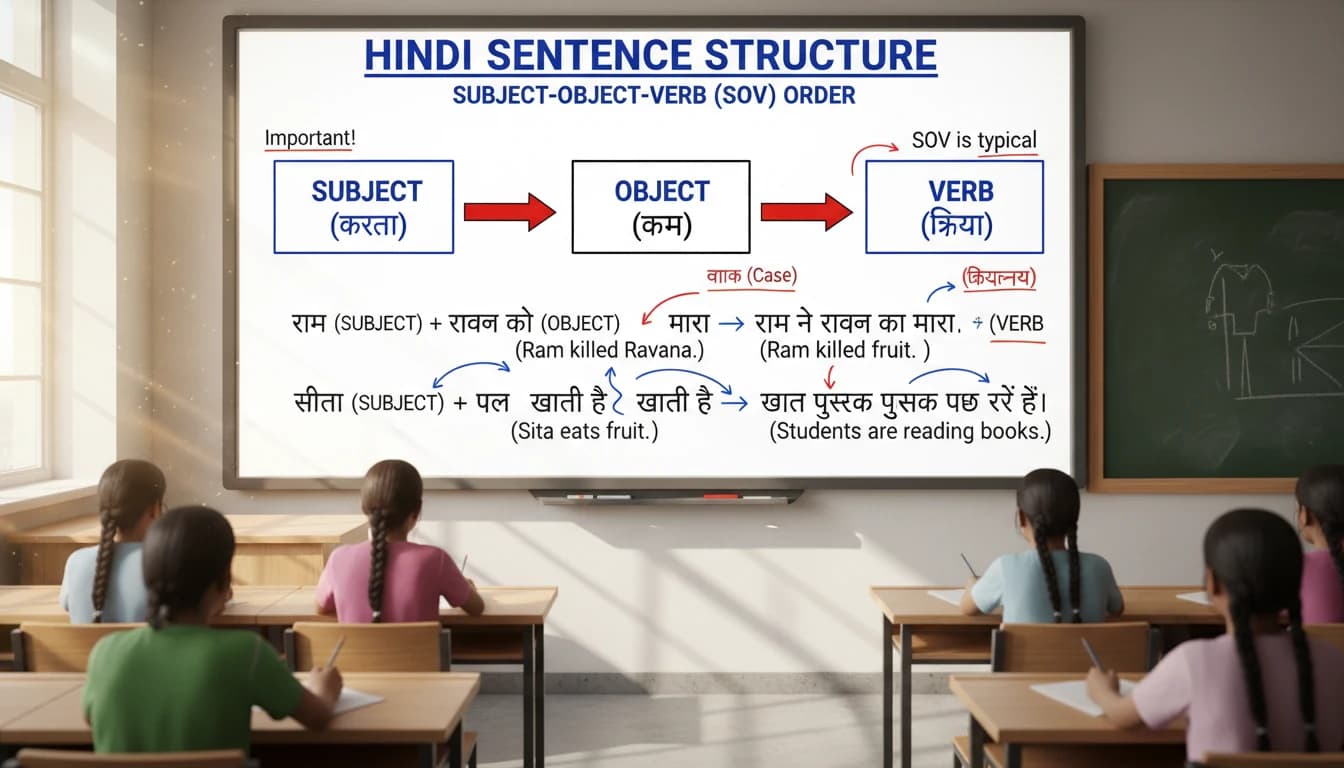
Hindi (हिंदी), one of the world's most spoken languages with over 600 million speakers, follows grammatical patterns quite different from English. The language uses the Devanagari script and has a Subject-Object-Verb (SOV) word order, unlike English's Subject-Verb-Object (SVO) structure. Understanding these fundamental differences is crucial for mastering Hindi grammar.
Hindi grammar is systematic and logical, following consistent rules once you understand the patterns. The language builds on a foundation of gender-based nouns, case markers, and verb conjugations that work together to create meaningful sentences. While this might seem complex initially, the regular patterns make learning progressively easier.
Gender in Hindi - Masculine and Feminine
One of the most fundamental aspects of Hindi grammar is gender. Every Hindi noun is either masculine (पुल्लिंग - pulling) or feminine (स्त्रीलिंग - striling). Unlike English, where gender is primarily biological, Hindi assigns gender to all objects, concepts, and living things.
Masculine Nouns
Masculine nouns typically end in आ (aa), but there are many exceptions. Common examples include:
- लड़का (ladka) - boy
- कमरा (kamra) - room
- दरवाज़ा (darwaza) - door
- फल (phal) - fruit
- पानी (paani) - water (masculine in Hindi!)
Feminine Nouns
Feminine nouns often end in ई (ee) or इ (i), though many end in other vowels or consonants:
- लड़की (ladki) - girl
- किताब (kitaab) - book
- मेज़ (mez) - table
- खिड़की (khidki) - window
- रात (raat) - night
💡 Pro Tip:
Learning the gender of nouns is crucial because it affects adjective agreement, verb conjugation, and sentence construction. Always learn new vocabulary with its gender!
Hindi Sentence Structure (Word Order)
Hindi follows a Subject-Object-Verb (SOV) word order, which is opposite to English's Subject-Verb-Object (SVO) structure. This is perhaps the most striking difference for English speakers learning Hindi.
Example Comparison:
English (SVO):
I eat food.
Hindi (SOV):
मैं खाना खाता हूँ। (Main khaana khaata hoon)
Literal: I food eat.
While the SOV structure is standard, Hindi allows some flexibility in word order for emphasis or poetic effect. However, beginners should master the basic SOV pattern first before experimenting with variations.
Pronouns in Hindi
Hindi pronouns change based on formality level, which is crucial for respectful communication. The language has three levels of formality:
Personal Pronouns
| Person | Informal | Formal | Very Formal |
|---|---|---|---|
| I | मैं (main) | Same | |
| You | तू (tu) | तुम (tum) | आप (aap) |
| He/She | वह (vah) | Same | |
| We | हम (hum) | ||
| They | वे (ve) / ये (ye) | ||
⚠️ Important Cultural Note:
Using "तू" (tu) with strangers or elders is considered extremely rude. Always use "आप" (aap) when in doubt. "तुम" (tum) is appropriate for friends and peers.
Verb Conjugation and Tenses
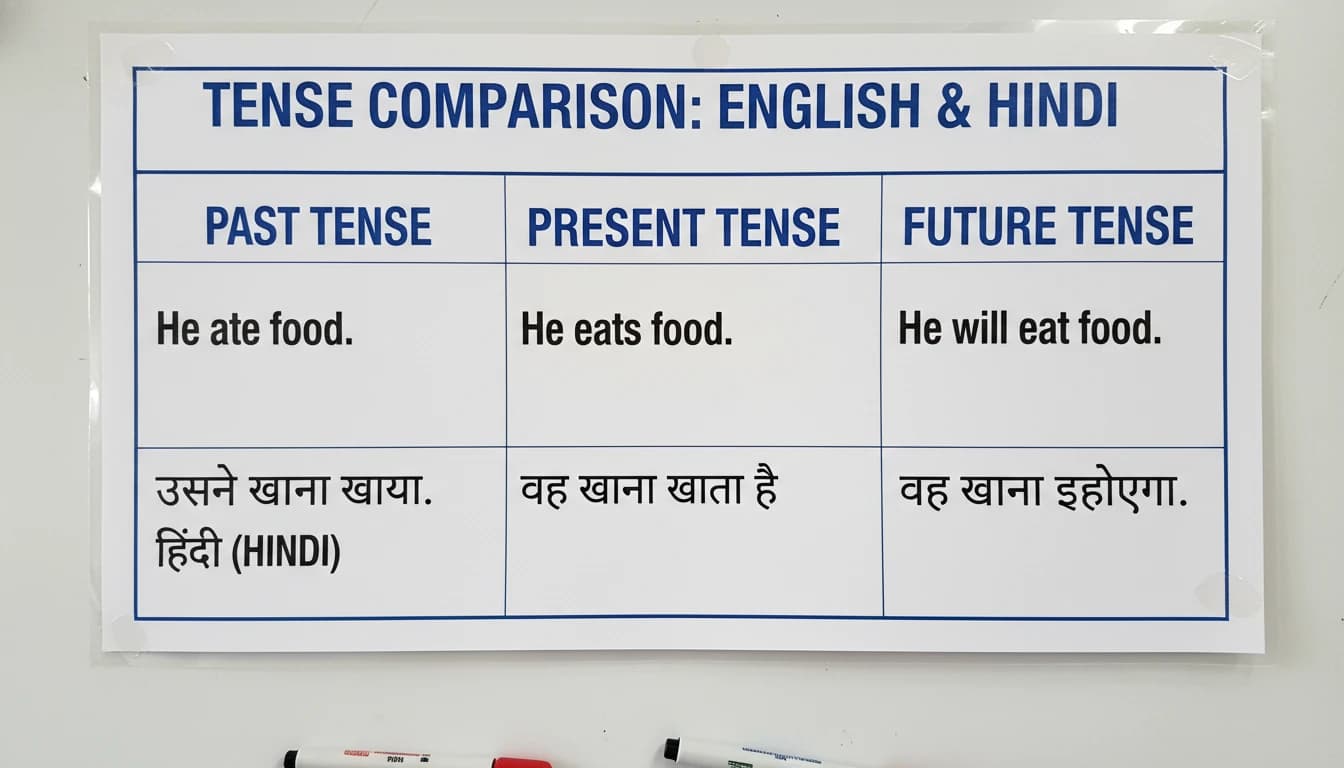
Hindi verbs conjugate based on gender, number, and formality level of the subject. The root form of verbs typically ends in "ना" (-na). For example, "खाना" (khaana - to eat), "जाना" (jaana - to go), "करना" (karna - to do).
Present Tense (वर्तमान काल)
The present tense in Hindi indicates actions that are happening now or actions that are habitual. Here's how to conjugate "खाना" (khaana - to eat):
Conjugation of खाना (khaana - to eat):
मैं खाता हूँ (main khaata hoon) - I eat (masculine)
मैं खाती हूँ (main khaati hoon) - I eat (feminine)
वह खाता है (vah khaata hai) - He eats
वह खाती है (vah khaati hai) - She eats
हम खाते हैं (hum khaate hain) - We eat
Past Tense (भूतकाल)
The past tense in Hindi is formed by adding specific endings to the verb root. Unlike English, Hindi past tense verbs agree with the subject's gender and number:
- मैंने खाया (maine khaaya) - I ate (masculine subject)
- मैंने खाई (maine khaayi) - I ate (feminine subject, feminine object)
- उसने खाया (usne khaaya) - He/She ate
- हमने खाया (humne khaaya) - We ate
Future Tense (भविष्यत काल)
The future tense indicates actions that will happen. It's formed by adding -ūṅgā/-ūṅgī/-oge/-egi endings to the verb root:
- मैं खाऊंगा (main khaa-unga) - I will eat (masculine)
- मैं खाऊंगी (main khaa-ungi) - I will eat (feminine)
- वह खाएगा (vah khaayega) - He will eat
- वह खाएगी (vah khaayegi) - She will eat

Postpositions (Not Prepositions!)
Unlike English, which uses prepositions (before the noun), Hindi uses postpositions - markers that come after the noun. These are essential for showing relationships between words in a sentence.
Common Postpositions:
- का/के/की (ka/ke/ki) - of, 's (possession)
- में (mein) - in
- पर (par) - on, at
- से (se) - from, by, with
- को (ko) - to (marks direct object)
- तक (tak) - until, up to
- के लिए (ke liye) - for
- के साथ (ke saath) - with
Examples:
- मेज़ पर (mez par) - on the table (not "पर मेज़")
- दिल्ली में (Delhi mein) - in Delhi
- राम का घर (Ram ka ghar) - Ram's house
- मुझे (mujhe) - to me (मुझ + को)
Adjectives in Hindi
Hindi adjectives change their form based on the gender and number of the noun they modify. There are two types of adjectives:
Variable Adjectives
These adjectives change based on gender and number, typically ending in आ/ा (aa/a):
- अच्छा (achchha) - good (masculine singular)
- अच्छी (achchhi) - good (feminine singular)
- अच्छे (achchhe) - good (masculine plural)
- अच्छी (achchhi) - good (feminine plural)
Invariable Adjectives
These adjectives remain the same regardless of gender or number:
- सुंदर (sundar) - beautiful
- खूबसूरत (khoobsurat) - gorgeous
- महान (mahaan) - great
Question Formation
Hindi questions use specific question words (प्रश्नवाचक शब्द) and often maintain the SOV word order:
| Hindi | Transliteration | Meaning |
|---|---|---|
| क्या | kya | what / (yes-no marker) |
| कौन | kaun | who |
| कब | kab | when |
| कहाँ | kahaan | where |
| क्यों | kyon | why |
| कैसे | kaise | how |
Numbers and Counting
Hindi uses unique number words that differ from English. Numbers 1-99 have distinct names, and the counting system can seem complex at first but follows patterns once learned.
Basic Numbers (1-10):
For a complete guide to Hindi numbers, visit our Numbers page.
Imperative Mood (Commands)
Hindi has three levels of commands based on formality, matching the three levels of "you":
- Casual (तू - tu): Verb root - जा (jaa - go!)
- Informal (तुम - tum): Verb root + ओ - जाओ (jaao - please go)
- Formal (आप - aap): Verb root + इए - जाइए (jaaiye - please go - respectful)
Common Grammar Mistakes to Avoid
1. Wrong Word Order
❌ मैं जाता हूँ स्कूल (Main jaata hoon school)
✅ मैं स्कूल जाता हूँ (Main school jaata hoon)
2. Gender Agreement
❌ वह अच्छा लड़की है (Vah achchha ladki hai)
✅ वह अच्छी लड़की है (Vah achchhi ladki hai)
3. Using Wrong Pronoun
❌ Using तू (tu) with strangers or elders
✅ Use आप (aap) for respect
Practice Resources
To practice Hindi grammar effectively, we recommend combining multiple learning methods:
- Use our Translation Tool to check your sentences
- Practice with Hindi Typing Tool to improve writing
- Study Example Sentences to see grammar in context
- Build vocabulary with our Word Meanings section
- Learn specific topics like Animals, Colors, etc.
Final Tips for Mastering Hindi Grammar
- Gender matters: Always learn nouns with their gender
- Practice SOV: Get comfortable with Subject-Object-Verb order
- Respect levels: Master when to use तू/तुम/आप
- Verb endings: Pay attention to masculine/feminine verb forms
- Postpositions: Remember they come AFTER the noun
- Immerse yourself: Watch Hindi content, read Hindi texts
- Practice daily: Consistency is key to mastering grammar
Frequently Asked Questions
What are the basic rules of Hindi grammar?▶
Hindi follows Subject-Object-Verb (SOV) word order, uses gender-based nouns (masculine/feminine), and verbs conjugate based on gender, number, and formality level. Understanding these fundamentals is key to mastering Hindi.
How important is gender in Hindi grammar?▶
Gender is crucial in Hindi as every noun is either masculine or feminine, which affects adjective agreement, verb conjugation, and sentence construction throughout the language.
What is the difference between तू, तुम, and आप?▶
तू (tu) is very informal/intimate, तुम (tum) is casual for friends/peers, and आप (aap) is formal/respecful. Always use आप with strangers, elders, or in professional settings.
How do Hindi verb tenses work?▶
Hindi has present, past, and future tenses. Verbs conjugate by adding specific endings to the root form, and these endings change based on the subject's gender, number, and formality level.
Can I learn Hindi grammar without a teacher?▶
Yes, with our comprehensive grammar guide, practice tools, and example sentences, self-study is absolutely possible. Consistency and daily practice are key to success.